Search This Blog

Showing posts with label thai food. Show all posts

Tuesday, June 30, 2015

Whats the Difference Between Thai Curry and Thai Soup?


Green Curry
Before I came to Thailand when I heard the word curry, I would always think of a creamy coconut milk based sauce filled with spices, a choice of meat, and maybe some herbs tossed in to make it look pretty.
Does this ring a bell?
Soup on the other hand, was a watery dish, typically not including too many spices, and filled with a combination of usually vegetables and some kind of meat.
I used to think a curry and soup were different by the spices they used and even the texture or thickness.
It wasn't until I came to Thailand and learned more about Thai food and the process of preparing Thai food, that I learned about the one fundamental difference.
To break down the difference between Thai curry and Thai soup, we have to begin with the two Thai words:
Gaeng (แกง) - Roughly translates to curry. Some examples:
  • Gaeng keow wan (sweet green curry แกงเขียวหวาน)
  • Gaeng massaman (massaman curry แกงมัสมั่น)
Tom (ต้ม pronounced more like dtome) - Tom does not just mean soup, but it really meansboil, and in English terms it refers to something that resembles a soup. Some examples:
  • Tom yum (tom yum ต้มยำ)
  • Tom saeb (sour Isaan soup ต้มแซ่บ)
  • Tom kha (coconut milk soup ต้มข่า)
So what's the difference between a gaeng and tom?
Paste.
That's the answer.
In Thailand a curry always begins with a curry paste, which is a blend of herbs and spices (lemongrass, garlic, chilies, kaffir lime leaves, galangal etc.), all pounded into a buttery paste using a mortar and pestle. From there, it can be mixed with meats and vegetables and either with coconut milk or water to form the base.
It can be thick and rich or it can be watery.
Traditional Thai curries in fact don't contain coconut milk at all, they are water based curries. Coconut milk in curries came under influence of India (I'll share more about the history of curry later on).
Let's move on to tom:
A tom in Thai, which relates more to a soup definition, is a boiled dish where the flavor comes from aromatic herbs (lemongrass, garlic, chilies, kaffir lime leaves, galangal etc. - notice a similarity?) - but they are NOT pounded into a paste like a gaeng - but instead, just sliced and boiled to release aromatic flavors.
So after eating gaeng and tom for some time while living in Thailand, one day it finally dawned on me:
The difference between a curry and a soup does not have to do with the spice or ingredients (necessarily), but it has everything to do with the cooking process.

Geang Som
One of the easiest examples I can think of to explain the difference between a Thai curry and Thai soup, are two southern Thai dishes that I eat frequently at home: gaeng som (sour curry) and tom som (sour soup). 
By English definition we could probably describe them both as soup, because they are both watery. 
But in Thailand, even though they contain relatively the same ingredients, the cooking process is completely different.
Gaeng som (แกงส้ม pictured above)
The basic ingredients in gaeng som are turmeric, lemongrass, garlic, and chilies all pounded into a paste, then mixed with water, fish, choice of vegetable etc. 

Tom Som
Tom som (ต้มส้ม pictured above)
The basic ingredients in tom som are turmeric, lemongrass, garlic, and chilies all sliced, then mixed with water, fish, choice of vegetable etc.
The difference is either paste (gaeng) or no paste (tom).
Part of eating Thai food is learning about Thai food and the process of what goes into the cooking!

Top posts of the month - June 2015


Blue Elephant
When I was in Phuket a few months ago, Ying and I had a meal at Blue Elephant in an elegant colonial mansion. Fantastic high-end food and a lovely atmosphere.


Paknam Krabi Seafood
Paknam Krabi Seafood is a Halal seafood restaurant in Krabi town. It's a good place to eat fresh seafood.


Premium Food Guides


Guides
If you're interested in learning more about eating and ordering authentic Thai food, check out my premium food eBook guides.


Let me know if you have any questions about Thai food, I'd love to hear from you. Just click "reply" to this message.

    - Mark Wiens (มาร์ค วีนส์)

Useful links:  Resources I Use  |  Food Guides  |  Thai Recipes
​​
P.S. Also, I just wanted to let you know, the "Eat More Tom Yum" t-shirts are on sale. Click here to get yours now!


MORE ABOUT THAI FOOD - IN THAIBIS CLICK HERE


Sunday, August 9, 2009

Thailand Street Vendors food how it started
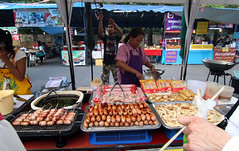
Thai Danger Dog & Sausage Vendor - Burapha Uni...Image by Marshall Astor - Food Pornographer via Flickr


Across Thailand, there is an array of street food vendors offering everything you could imagine and more. Street vending in Thailand was originally established by Chinese immigrants in Bangkok seeking a vehicle for upward economic mobility during the second half of the 19th century. The decrease in value of rice world-wide after World War I prompted rural Thais to move to Bangkok, resulting in more Thai street food vendors. Thais typically eat many small meals a day, and prefer to meet with friends outside of the home. Street food vending offers a cheaper alternative to formal restaurants and small portions suited for nibblers. As a consequence, street vending rapidly expanded over the past 60 years to make it a hallmark of Thai culture.
Pad Thai is perhaps the most well-known Thai dish in the Western world.

Vendor GirlImage by notashamed via Flickr

While the name literally means Thai-style fried noodles and is sometimes referred to as “the national dish of Thailand,” the truth is that this dish isn’t entirely of Thai origin. The process of making rice noodles was imported to Southeast Asia from China and the method for preparing and the style of noodles used (banh pho) were Vietnamese. The dish was popularized in Thailand by former Prime Minister Luang Pibulsonggram around World War II in an effort to reduce the country’s rice consumption.


Pad Thai (close up)Image via Wikipedia


While not commonly prepared in Thai home kitchens, Phad Thai can be found throughout Thailand at a number of street vendor stalls. In Thailand, pad Thai is served relatively dry with less oil and sauce. It is seasoned with tamarind juice and red chilli pepper and typically garnished with cilantro, bean sprouts and peanuts.


What sets this dish apart from its competitors is the enticing aromas that fill the air. Shallots, garlic, and peppers lure in patrons who patiently linger with their mouths watering.

READ OUR FORUM STORY ON PANG LOI (STREET DENDOR FOOOD)


Links

Recipe for Phad Thai

Common Dishes from Street Vendor Food (Pang Loi)

Travel Thailand

===============================================================